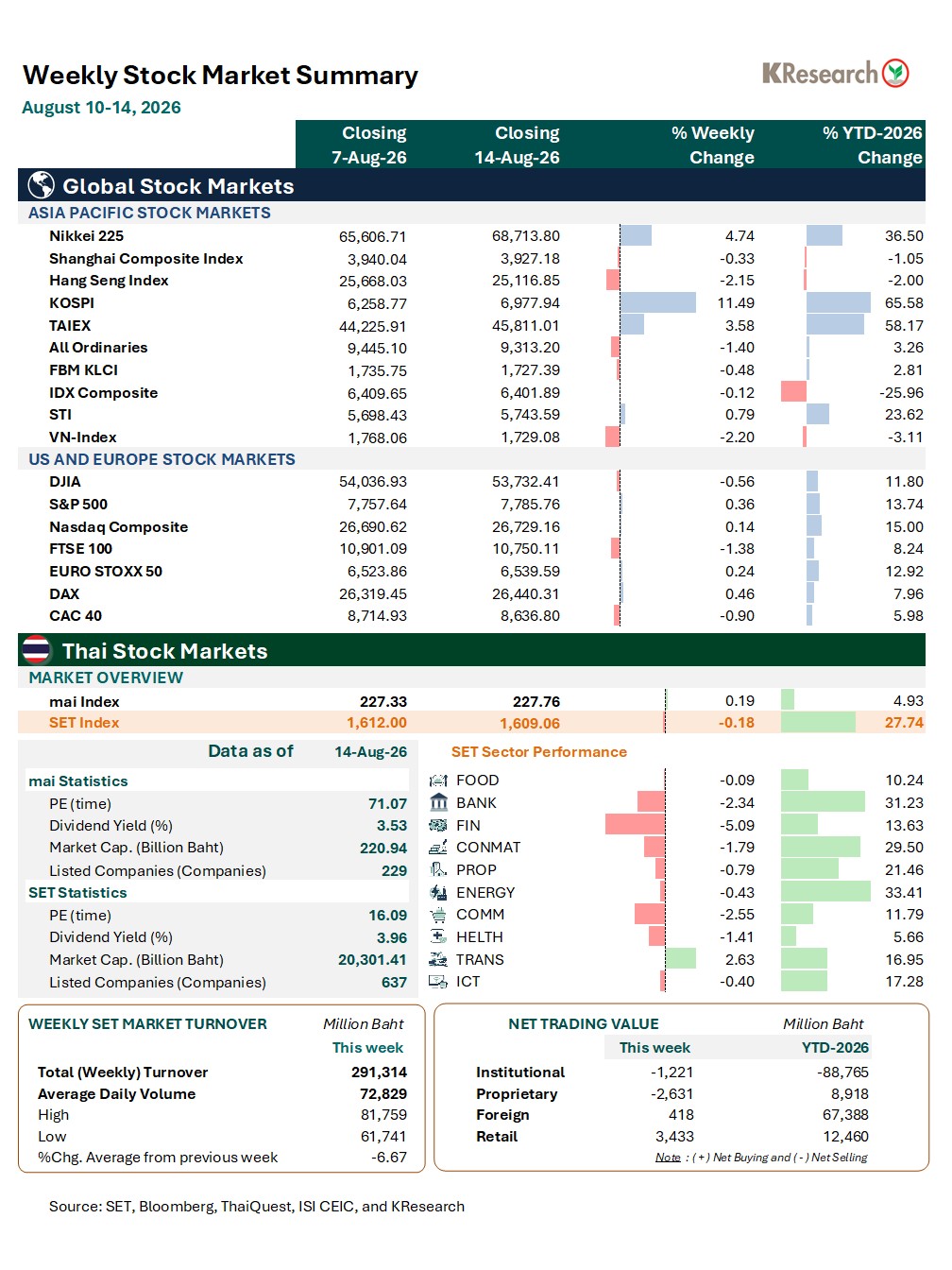
• The Thai stock market fluctuated before turning lower towards the end of the week.
The SET index initially rose in line with other regional bourses, supported by expectations that the Fed would not rush to raise interest rates after the US July non-farm payroll figures came in lower than expected. Electronic component manufacturers led the gains, benefiting further from the recovery in global technology stocks. However, the SET Index later declined ahead of the domestic market holiday on August 12, as the market became concerned about the situation in the Middle East, assessing that negotiations to reopen the Strait of Hormuz were unlikely to be reached anytime soon.
The SET Index traded within a narrow range before declining towards the end of the week. Although the market initially received support from softer-than-expected US inflation data for July, which strengthened expectations that the Fed would be more likely to keep interest rates unchanged at its September meeting, investor sentiment later turned cautious following reports that the US had warned it could impose unprecedented economic measures against Iran. As a result, profit-taking emerged across several sectors, led by banking stocks. Investors were also awaiting Thailand’s 2Q-2026 GDP, scheduled for release next week.
• On Friday, August 14, 2026, the SET closed at 1,609.06 points, down 0.18 percent over-week. The average daily trading value was THB72,828.53 million, down 6.67 percent over-week. The mai closed at 227.76 points, up 0.19 percent over-week.
• During August 17-21, 2026, KSecurities expects the SET to have support at 1,585 and 1,560 points, but resistance at 1,620 and 1,630 points, respectively. KResearch advises investors to watch key factors, including Thailand’s GDP report for 2Q-2026, developments in the Middle East, and foreign capital flows. US economic data that warrants close monitoring includes July Housing Starts, Industrial Production, August Manufacturing and Services PMI (Flash), FOMC minutes, plus weekly jobless claims. Other important overseas economic indicators to monitor include Japan’s GDP report for 2Q-2026, China’s August LPR and July economic data such as Industrial Production, Retail Sales and Fixed Asset Investment, July CPI of Eurozone and Japan, plus August Manufacturing and Services PMI (Flash) of Japan, Eurozone and UK.
Enter the code from the poll
Annotation
This research paper is published for general public. It is made up of various sources. Trustworthy, but the company can not authenticate. reliability The information may be changed at any time without prior notice. Data users need to be careful about the use of information. The Company will not be liable to any user or person for any damages arising from such use. The information in this report does not constitute an offer. Or advice on business decisions Anyhow.